

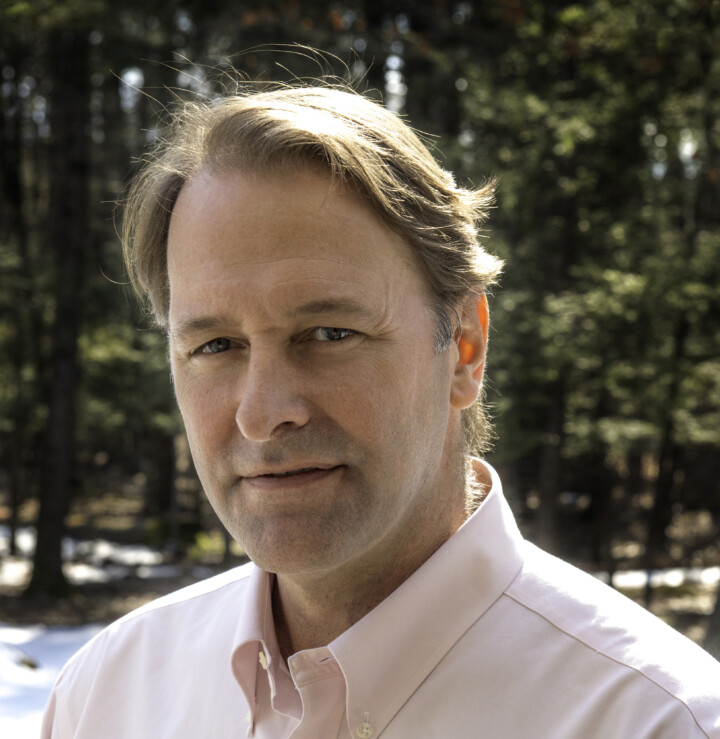
The best things in life happen when you get carried away. I went into a cooking school to write about what it means to be a chef, and instead I became a cook, got a job line cooking, lucked into one of the great restaurants of the world to work with the chef on his book, and I kept on writing about food. I got carried away, and it’s made all the difference.
The facts are these: Born 1963 in Cleveland, graduated Duke in 1985 with a BA in literature, worked at The New York Times as a copyboy where I managed to slip some stories into most sections of the paper, departed after fewer than two years to pursue a desultory life of writing, travel and odd jobs, returning to Cleveland with my wife, Donna, a newspaper and magazine photographer, in 1991. Found work at a local magazine covering arts and cultural scene and here began writing about chefs and cooking.
My first book, Boys Themselves (1996), revealed life at an all-boy day school that was defiantly all-boys at a time when anything all-boys was considered toxic and anything all-girls was great for girls.

My kitchen: when I'm not writing or reporting, this is where I spend a lot of my time.
A committed cook since fourth grade, I proposed to the Culinary Institute of America, the oldest and most influential professional cooking school in the country, that I be allowed into its kitchen classrooms in order to write a narrative of how the school trains professional chefs. The school agreed, and I wrote The Making of a Chef (1997), rereleased in 2009 in a new paperback edition.
I became so fascinated by the work of the professional cook and the culture of the restaurant kitchen that I continued to pursue the work and wrote a book about chefs and cooking, The Soul of a Chef (2000). I co-wrote The French Laundry Cookbook (1999) with Thomas Keller at the same time, and he and I subsequently wrote a food column for the Los Angeles Times for two years.
In February 1999, I moved with my family to Martha’s Vineyard to research and report on life at a yard making plank-on-frame boats for the book Wooden Boats: In Pursuit of the Perfect Craft at an American Boatyard (2001). In October 2000, I began work at the Cleveland Clinic’s Children’s Hospital for the book Walk on Water (2003). I wrote it concurrently with A Return to Cooking (2002), with Eric Ripert, chef-owner of Le Bernardin, the Manhattan four-star restaurant.

Tony Bourdain lured me to Vegas for his show No Reservations; ever image conscious, he was infuriated by my Cleveland pallor and insisted I do something about it before we hit town. Photo by Nari Kye,courtesy of The Travel Channel, L.L.C.
Other books include House: A Memoir, about the purchase and renovation of a 1901 house in Cleveland and an exploration of the nature of home in our vagabond culture, and The Reach of a Chef: Professional Cooks in the Age of Celebrity. Other cookbooks include Bouchon, written with Keller and the others from the French Laundry Cookbook team, about French comfort food, and Under Pressure, the first American cookbook to explore the possibilities of sous vide cooking. I was a contributor to the Alinea, Grant Achatz’s tour de force on the new new cuisine. I wrote Charcuterie: The Craft of Salting, Smoking and Curing–a thinly veiled love song to the pig, to animal fat and salt, sausages, confits, pates, terrines–with my friend, the Michigan chef Brian Polcyn.
I have been on several television shows, “Cooking Under Fire” on PBS, and, on the Food Network, I was a judge on the “Next Iron Chef,” appear occasionally as a judge on “Iron Chef America,” and have been a featured guest on the Travel Channel’s “Anthony Bourdain’s No Reservations,” Las Vegas and Cleveland episodes.

Judgment in the Next Iron Chef competition in Munich. From left, Bernd Schmitt, myself, restaurateur Donatella Arpaia, editor Andrew Knowlton, and host, Alton Brown interrogate San Francisco chef Chris Cosentino. Photo courtesy of The Food Network
In 2007 I published The Elements of Cooking: Translating the Craft for Every Kitchen, “an indispensable compendium of cooking information for both professional and amateur cooks constitutes a precise, unpretentious, unencumbered culinary handbook” (Booklist). I realized one day leaving a food writers symposium that I’d spent so much time in kitchen and so much time with the country’s best chefs that I had a huge amount of knowledge about cooking, information that would be valuable to anyone who cared about cooking, from professional chefs to committed home cooks. Needing a structure for all this information I turned to one of my favorite books about the craft of writing, Strunk and White’s The Elements of Style. The book contains essays on the fundamentals of cooking and a deeply opinionated glossary of important cooking terms we all need to know.
My most recent book is Ratio: The Simple Codes Behind the Craft of Everyday Cooking, a book devoted to understanding the relationships between our most basic ingredients and how those relationships form the backbone of the craft of cooking.
This fall two new cookbooks I’ve had a hand in will be published: Thomas Keller: At Home with Ad Hoc, the fourth from this team, and Symon Says: Live to Cook, a cookbook from my friend, fellow Clevelander, Michael Symon, chef-restaurateur (Lola/Lolita) and an Iron Chef Food on Network’s “Iron Chef America.” Donna and I continue to live in Cleveland Heights with our two kids, writing, shooting and cooking.


Hi Michael, I just love your book Ratio: the Simple Codes Behind the Craft of Everyday Cooking. It has very clever information and gives us so many secrets that make cooking easy and without mysteries. Thank you so much and keep up the good work.
Thanks for sharing your knowledge and experience!
Last paragraph above says, “and an Iron Chef Food on Network’s ‘Iron Chef America.’” I’m pretty sure that’s not what you meant to write. LOL
I received my Spankettes today and they are very nice! I wish they had shorter handles (7″) I have one that has shorter handles and I find it is much easier to use in shallow pans. Thanks again!
Hi Michael-
Very much enjoyed meeting you at the Dahlia tonight. Inspiring comments. Thanks for coming out at this time of the year. Can’t wait to dive into your latest work. Will try and email photo from event soon.
I’m a culinary student right now, and your books are so helpful!
Please explain what three fingers of water mean that you
included in your recipe in the paper Sunday. I have never
heard that expression before. I got the three finger shakes of salt, so
I’m ready to try the chicken recipe but don’t know how much water
is needed. thanks for your reply.
saw you on ming tsai and would like to be on your e and snail mail. thanks.
whoah this blog is wonderful i love studying your articles. Stay up the great paintings! You realize, lots of people are hunting round for this info, you could aid them greatly.
Excellent learn, I simply passed this onto a colleague who was doing a little analysis on that. And he truly bought me lunch as a result of I found it for him smile So let me rephrase that: Thanks for lunch! Anyway, in my language, there aren’t a lot good source like this.
There are definitely lots of particulars like that to take into consideration. That may be a great point to bring up.
Thanks so much for giving everyone an extraordinarily pleasant possiblity to check tips from this blog. It really is so pleasant and as well , jam-packed with a good time for me and my office mates to search your site on the least 3 times in 7 days to read the latest things you have got. And definitely, we are at all times astounded concerning the mind-blowing ideas you serve. Selected 1 facts on this page are really the most beneficial I’ve ever had.
Witty! I’m bookmarking you site for future use.
excellent posting, i definitely enjoy this amazing site, keep on it.
You have mentioned very interesting details ! ps nice site.
I simply couldn’t go away your web site before suggesting that I extremely enjoyed the usual information an individual provide on your guests? Is going to be back regularly to check up on new posts